Observability
Watch the factory floor
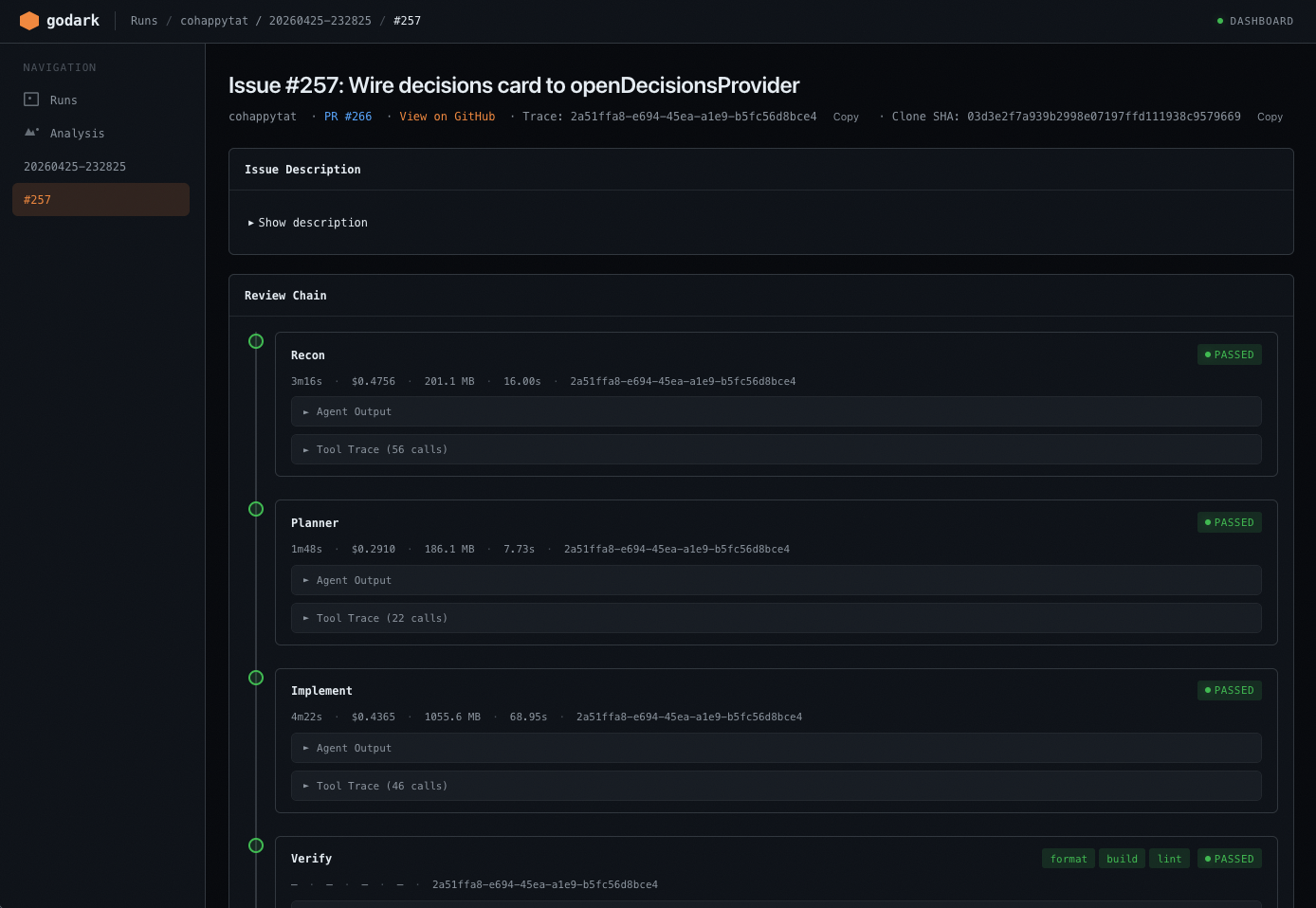
The built-in dashboard shows run history, per-issue outcomes, costs, and agent logs in real time.
localhost:8374
A CLI built for Claude Code that orchestrates autonomous agents to implement GitHub issues, review their own work, and merge — without human intervention (unless you want it).
The hard part of software engineering isn't typing code — it's deciding what to build and how it fits. Dark Factory keeps those decisions with humans.
Engineers write the roadmap, define architecture layers, design conventions, and author issue specs. Agents operate within those constraints. The harness is the design.
This isn't "point an AI at a ticket and hope for the best." Every judgment call that shapes a codebase stays with the humans who understand it.
Discuss layers, dependencies, and boundaries. Write machine-readable definitions that agents and reviewers enforce.
Error handling patterns, test style, naming rules, dependency injection — codified and validated, not left implicit.
Conversational planning — discuss goals, break into phases, define acceptance criteria and scenario specs for every issue.
Implement, review, and merge — constrained by the architecture you defined, the conventions you wrote, and the specs you authored.
Dark Factory has been built entirely by its own agent pipeline. Every feature was implemented, reviewed, and merged by godark run. The humans write specs and design harnesses; the agents write code.
When you can stand up a purpose-built internal tool faster than you can procure a vendor, building in-house becomes the obvious choice.
Instead of cutting headcount, expand what your team can accomplish. Explore new verticals. Ship products that would have been too risky to staff. Build bespoke tools — without the six-month timeline or per-seat pricing.
The risk of missing market fit used to be a staffing decision. Now it's an API bill. Cheap to experiment, trivial to throw away.
Design architecture layers, write conventions, and set auto-merge policy. The constraints are the product — good boundaries mean agents produce clean code without fighting the structure.
Decompose milestones into agent-sized issues, operate runs, and tune prompts when analytics show recurring mistakes. The feedback loop between specs and output is where craft lives.
Write issue specs, author scenario tests, and verify agent PRs against punchlists. Learning to define "correct" before code exists builds the foundations that make them mid-level.
Own the scenario spec corpus and verification pipeline. Good scenarios catch bugs before humans see the PR — QA's work directly drives down retries and cost.
Each issue runs through an autonomous implement → review → merge cycle. No human in the loop unless you want one.
An agent reads the issue, scenario specs, and architectural constraints — then writes the code on an isolated branch inside a Docker sandbox.
A second agent audits code quality. A third reviews against scenario specs. Failed reviews trigger automatic fix cycles — up to your configured retry limit.
Approved PRs are squash-merged automatically. The next unblocked issue starts. Dependency chains are resolved so issues process in the right order.
Agents run inside Docker containers with protected paths, denied commands, and no access to your host environment.
Issues declare blockers. Dark Factory resolves the dependency graph and processes issues in topological order.
Define expected behavior in markdown. The functional reviewer validates implementations against these specs — not just code style.
Every run records outcomes, costs, retry counts, and prompt gaps. Query across runs with godark analyze.
Auto-merge all, only low-risk changes, or nothing. Feature branches and rollup branches have independent merge strategies.
Nine built-in skills scaffold roadmaps, planning docs, issues, scenario specs, architecture definitions, and more — all from slash commands.
The built-in dashboard shows run history, per-issue outcomes, costs, and agent logs in real time.
Install godark, configure your first project, and run the autonomous loop on a demo repository.
→Complete reference for all 14 commands — flags, options, and usage examples.
→Deep dive into godark.yaml — runtime, Docker, merge strategies, modules, notifications, and more.
→Nine slash commands that scaffold roadmaps, planning docs, issues, architecture, conventions, and more.
→Dark Factory is not a product. There's no hosted plan, no central servers, no account to create, and no usage data collected. It's a CLI that runs on your machine.
Your security posture doesn't change by adopting it. You're already using GitHub and Claude Code — Dark Factory just orchestrates them. A single binary, no infrastructure fleet, no additional vendors to evaluate.
Agents run inside ephemeral Docker containers with no access to your host filesystem or network beyond what you explicitly configure. Protected paths, denied commands, and sandboxed execution are on by default.
All run data, logs, and analytics stay in ~/.godark/ on the developer's workstation. There are no central servers, telemetry, or phone-home behavior.
Dark Factory uses your GitHub token and your Anthropic API key or Claude Code subscription. We never see your credentials.
Licensed under Elastic License 2.0. Use it on any project — open source or proprietary. The only restriction: you can't resell it as a hosted service.
There's no company behind this, no investors, no paid tier coming. The goal is to light a path forward that gives humans creative control over their software while fully leveraging Claude Code.